Higher Education
with the integration of *Ethics - Relationships - Cognition*
What is the Ethics-Relationships-Cognition (ERC) curriculum?
*Answer: Real-life educational lesson plans for all ages.
At its core, the ERC curriculum is grounded in the following two foundational components:
1. First Principles: You live in a structured society. Structure means framework.
Framework means rules, laws, and governance.
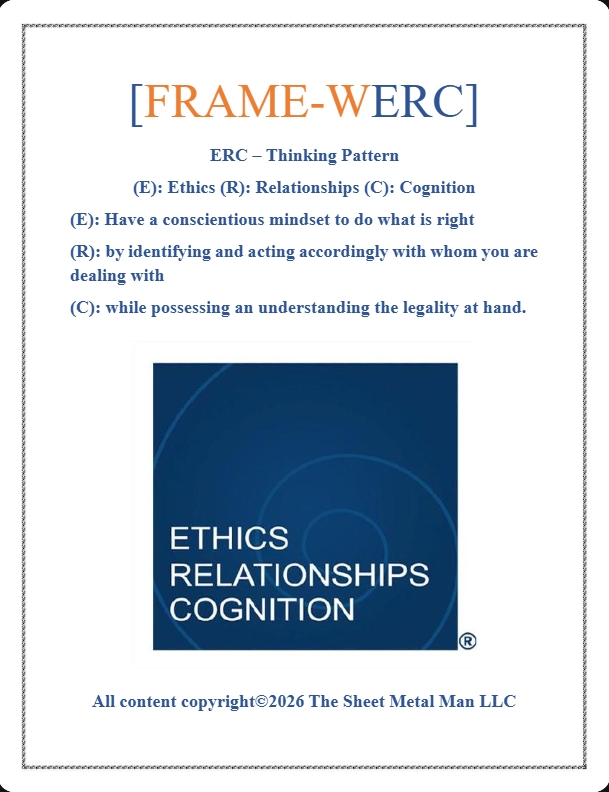
2. Operational Framework (ERC Thinking Pattern)- (E): Ethics (R): Relationships (C): Cognition
Higher Education
(E): Have a conscientious mindset to do what is right
(R): by identifying and acting accordingly with whom you are dealing with
(C): while possessing an understanding of the legality at hand.
There’s a problem people feel—but can’t clearly explain. You’ve heard the claims: “The system is broken.” “It’s designed to keep you limited.” “They don’t want you to know.”
But those statements lack precision. The system isn’t broken. It’s structured. And if you don’t understand the structure, you will misinterpret everything that happens inside of it.
Let’s reduce it to first principles: You live in a structured society. Structure means framework. Framework means rules, laws, and governance.
Now here’s the critical shift: Education is not designed to give you a complete understanding of that framework. It gives you functional access—just enough to participate, not enough to fully interpret. And that gap—between participation and understanding—is where mistakes are made. Not random mistakes. Patterned mistakes. And patterned mistakes produce predictable outcomes. This is where the ERC framework becomes non-optional. Because every mistake you make will fall into one of three domains: Ethics. Relationships. Cognition.
If your Ethics are misaligned, you misjudge right and wrong within the system—leading to decisions that carry legal, moral, or financial consequences.
If your Relationships are misaligned, you misread people, authority, and influence—placing trust in the wrong structures and mismanaging social positioning.
If your Cognition is underdeveloped, you misinterpret the system itself—failing to recognize patterns, frameworks, and cause-effect relationships that govern outcomes.
Now connect this: When education omits structured development in Ethics, Relationships, and Cognition simultaneously, it doesn’t just leave gaps. It produces individuals who can operate—but not accurately interpret. And when interpretation is off, decisions are off. And when decisions are off, consequences follow.
Here’s the reality most people never articulate clearly: In a structured system, your errors are not wasted. They are absorbed. Every ethical misstep, every relational miscalculation, every cognitive blind spot—creates downstream effects that advantage those who do understand the framework. That’s how systems sustain themselves. Not through chaos—but through asymmetry of understanding. So, the issue isn’t access to education. The issue is architecture of understanding.
If Ethics are not structured—your decisions lack grounding.
If Relationships are not structured—your positioning lacks awareness.
If Cognition is not structured—your interpretation lacks accuracy.
And without all three aligned, you remain reactive inside a system that rewards precision. That’s why ERC is not a theory or philosophy.
It’s a corrective model. A way to move from participation… to accurate interpretation… to controlled outcomes.
Because once you can see the structure clearly—You stop making predictable mistakes and you stop producing predictable losses.
Within the context of higher education, ERC’s model serves as a foundational precursor and parallel support system. Students who enter post-secondary environments with an established ERC-based cognitive framework demonstrate enhanced capacity for abstract reasoning, disciplined inquiry, and principled decision-making. Rather than merely navigating higher education as a sequence of academic requirements, these individuals engage it as a coherent system—understanding not only what to learn, but how and why knowledge is structured, applied, and institutionalized.
In this way, ERC does not replace higher education; it optimizes readiness for it. By systematizing thought at the developmental level, ERC enables learners to extract greater value from post-secondary experiences, positioning them to function with clarity, autonomy, and strategic awareness within increasingly complex societal systems.
——————————————————–
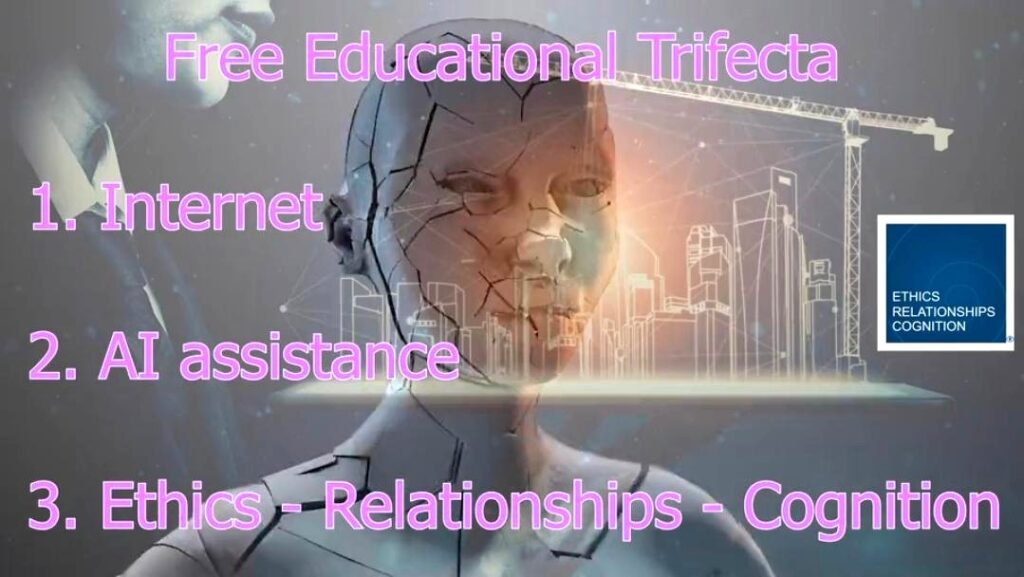
The nature of learning itself is changing. A new model is emerging as people recognize the free educational trifecta now available to every American:
the internet, AI assistance, and the thinking pattern of Ethics–Relationships–Cognition.
ERC Thinking Pattern – (E): Ethics (R): Relationships (C): Cognition
(E): Have a conscientious mindset to do what is right
(R): by identifying and acting accordingly with whom you are dealing with
(C): while possessing an understanding of the legality at hand.
Together, these tools provide universal access to a world-class education without institutional gatekeeping.
Institutional gatekeeping: The intentional withholding of valuable information from integration into educational curricula.